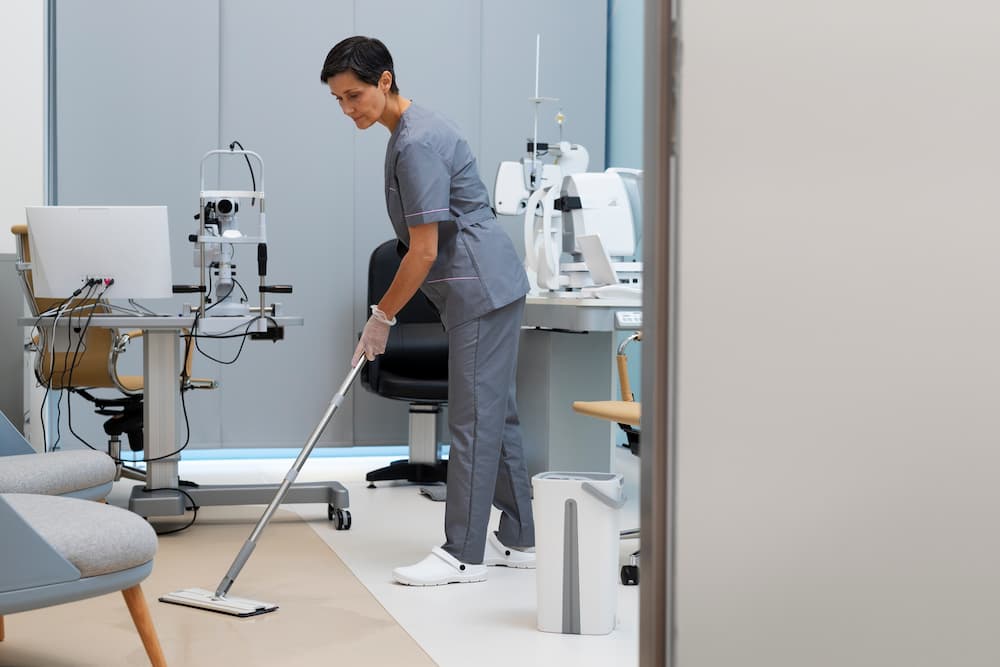
Hospital cleaning staff play a critical role: cutting the chain of infection and ensuring safe spaces for patients and professionals. If you want to apply, here are the requirements to work in hospital cleaning, the most valued training and a plan to join with guarantees. We integrate operational practices from Weldon (a facility services company) so that you know what the centres ask for and how to prepare yourself.
Professional profile: what hospitals are really looking for
Beyond previous experience, healthcare facilities prioritise three things: protocol compliance, safe work habits and shift reliability. At Weldon we assess attitude, punctuality and the ability to follow instructions precisely, because the standard of hospital cleaning does not allow for short cuts.
Essential requirements (and how to demonstrate them)
Prepare this documentation and skills. Submitting them from day one accelerates your recruitment.
| Requirement | What it accredits | How it is proven |
| DNI/NIE and work permit | Identity and work eligibility | Legible copy on both sides and validity |
| Occupational medical fitness | Suitability for tasks involving biological/chemical agents | Recognition of the prevention service of the centre or provider |
| Basic ORP training | Safe work, PPE and signage | ORP certificate (20h-30h courses; cleaning/services) |
| Good cleaning and disinfection practices | Procedures by area (low/high criticality) | Specific diplomas or proof of internal training |
| Safe handling of chemicals | SDS reading, dilutions and labelling | Documented training by the provider or company |
| Vaccination according to the risks of the job* | Protection against foreseeable exposures | Vaccination registry and prevention service criteria |
| Shift availability | 24/7 coverage, touch-ups and isolations | Declaration of slots and weekends |
*The specific vaccination schedule is determined by the prevention service of the health centre according to risk assessment.
At Weldon we usually go through all these points before joining a unit, to ensure the shortest possible learning curve.
Skills that make a difference
- Traceability and order: following task lists and completing work sheets without errors.
- Technique: from clean to dirty, movements from top to bottom, colour-coded cloths, contact times.
- Brief communication: report incidents with data: location, type of waste, action taken.
- Self-monitoring: Correct PPE, hand hygiene and respect of restricted areas.
In our team we train “micro gestures” (changing cloths, closing bags, removing PPE) because this saves seconds and avoids recontamination.
Duties of hospital cleaning staff
Tasks vary by area, but the standard is clear: avoid biofilm, hygiene breaks and risks to vulnerable patients.
- Rooms and ICU: terminal/inter-patient cleaning, high contact surfaces, furniture and floors.
- Operating theatres and critical areas: validated sequence, disinfectant contact times and cross-checking.
- Common areas: lifts, public toilets, waiting rooms, with reliable replenishment of consumables.
- Sanitary waste: segregation by codes, closure and transfer in authorised circuits.
At Weldon we differentiate protocols based on risk levels and record contact times of disinfectants for auditing.
7-day access plan (if you start from zero)
A short itinerary to be ready and stand out in your application.
- Day 1: 1 page CV with shift availability and related experience (residential, industrial cleaning).
- Days 2–3: Course on ORP and handling of chemicals (dilutions, SDS, pictograms).
- Day 4: Hospital cleaning module: criticality zones, colour-coded cloths, contact times.
- Day 5: Route simulation: toilet, high contact surfaces, replenishment and waste.
- Day 6: Prepare your interview “kit”: Basic PPE, examples of work sheets and check-list.
- Day 7: Apply and check high availability; answer calls from unknown callers.
In our case, candidates who master dilutions and contact times move earlier to sensitive units.
Mistakes that hold back recruitment (and how to avoid them)
- Generic CV: create a health version with keywords: “terminal”, “high contact”, “sanitary waste”.
- Ignorance of PPE: review gloves, masks, goggles and their fitting/removal sequence.
- Estimated dilutions: always use dosing systems and exact measurements.
- Lack of traceability: no signed forms, no audit; record every task.
At Weldon, we place particular value on traceability: error-free reporting and clear communication with nursing.
Brief Frequently Asked Questions
- Is previous experience necessary? Not always; with specific training and a good attitude, you can start in less critical areas.
- What shifts are there? Morning/afternoon/evening, public holidays and touch-ups due to isolation or peak occupancy.
- What products are used? Approved detergents/disinfectants and closed dosing systems; never improvise.
- Is work carried out in teams? Yes, per route; coordination with nursing and maintenance is constant.
Take the next step with a specialised partner
If you manage a centre and need to cover peaks, standardise protocols and audit results, meet our comprehensive cleaning company. And if you are looking for a specific deployment in healthcare environments (hospitals, clinics, nursing homes), explore our hospital cleaning company service. Weldon integrates training, monitoring and KPIs to ensure consistent quality.
Express check-list before applying
Check in 10 minutes:
- PDF-ready ORP and chemicals certificates.
- Shift and weekend availability.
- You know colour-coded cloths and contact times.
- You are able to complete a work form and report incidents.