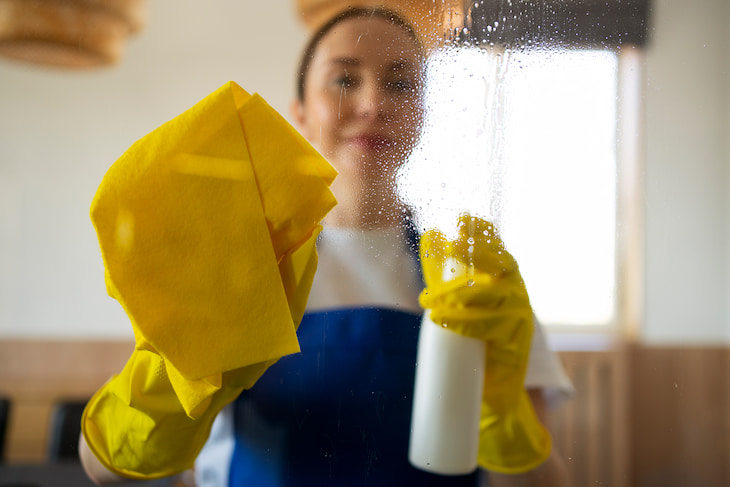
Cleaning in university residence halls is not the same as in an office: there is a turnover of residents, intensive use of communal areas and peaks in workload (arrivals, departures, exams). For this reason, staff profiles and requirements must be precisely defined to ensure hygiene, a harmonious living environment and a positive impression of the centre.
Why a university residence hall requires a specific profile
In a residence hall, cleaning staff work in an environment of constant interaction, where any slip-up is quickly noticed: odours in corridors, blocked toilets, shared kitchens, overflowing bins or high-touch surfaces left unsanitised. Furthermore, the team often interacts with students, reception and maintenance staff, so attitude and discretion are just as important as technical skills.
Another key factor is the variability of the service: some days are steady paced, whilst others bring real pressure (room changes, moves, incidents, events, sales visits). The ideal candidate is organised, decisive and able to maintain standards without losing their cool.
Duties of cleaning staff in university residence halls
Before hiring, it is advisable to ‘map out’ the service: what is cleaned, how often and to what level of detail. The residence hall is a collection of micro-spaces with different needs, and staff must master area-specific routines to avoid improvisation.
These are the standard duties, which can be adapted depending on the residence hall model (with a dining hall, shared kitchens, room cleaning included, etc.).
Rooms and private areas
When the residence hall includes room cleaning, the priority is to maintain a consistent standard without invading privacy. Discretion and respect for personal belongings and spaces are key here.
- Airing and waste disposal.
- Dusting and cleaning frequently used surfaces.
- Floor cleaning (vacuuming/mopping depending on the material).
- Visual inspection for issues (damp, breakages, pests) and internal communication.
The key is to work to a clear protocol: what can and cannot be touched, how to access areas, and how to log the service to avoid misunderstandings.
Shared bathrooms and toilets in communal areas
Toilets are a critical area in terms of hygiene, odours and perception. Staff need the skills to carry out effective cleaning and disinfection in line with actual usage, without merely ‘skimming the surface’.
- Sanitary facilities: toilets, showers, washbasins, taps and screens.
- Replenishment of consumables: paper, soap, hand dryers/bags.
- Treatment of floors and drains.
- Control of limescale and recurring stains (weekly intensive cleaning plan).
A good candidate understands the difference between cleaning and disinfecting, and prevents cross-contamination by using tools and products segregated by colour or area.
Kitchens, dining rooms and kitchenettes
In residence halls with shared kitchens or dining areas, staff must work with food safety in mind: surfaces, grease, extractor hoods, appliances, cold storage (where applicable) and the removal of organic waste.
- Worktops, sinks, hobs and unit fronts.
- Degreasing and maintenance of areas prone to build-up.
- External cleaning of fridges, microwaves and small appliances.
- Waste bin management: cleaning, bin liners and odours.
As well as hygiene, tidiness is key here: if the space is organised, wear and tear is reduced and incidents involving residents are minimised.
High-traffic communal areas
Reception, corridors, lifts, study rooms, leisure rooms and laundry areas are prone to fingerprints, stains and contact. A good team works with smart frequencies: more frequent, short and consistent cleaning passes, rather than a single, lengthy clean that comes too late.
- Door handles, handrails, light switches, button panels and counters.
- Carpets or delicate flooring: vacuuming, stain removal and maintenance.
- Accessible windows and mirrors.
- Management of bins and recycling points.
When staff understand the ‘map’ of critical areas, this reduces the occurrence of the typical complaint of “it looks clean, but it isn’t”.
Ideal profile: technical and interpersonal skills
Hiring based on generic experience may fall short. In residence halls, the ideal profile combines practical skills with social skills. What makes the difference is consistency: maintaining the standard every day, not just during audits.
Essential technical skills
More than just “knowing how to clean”, you need the judgement to choose the right method, tool and product according to the surface and risk. This prevents damage (parquet, vinyl, stainless steel), reduces consumption and improves results.
- Knowledge of surfaces and treatments (wood, porcelain tiles, carpet, stainless steel).
- Correct use of products: dosage, contact times, incompatibilities.
- Area-specific procedures: bathrooms, kitchens, bedrooms and hallways.
- Handling of basic equipment: professional vacuum cleaner, floor scrubber, rotary machine (if applicable).
A practical indicator: staff who do their job well leave the space ‘stable’, not just ‘presentable’.
Attitudinal skills that reduce incidents
In a university residence hall, living together can lead to friction if staff do not behave appropriately. The right attitude enhances the residents’ experience and protects the institution’s reputation.
- Discretion and respect for private spaces.
- Basic communication and polite behaviour.
- Time management: prioritising without compromising on quality.
- Ability to report incidents clearly (what happened, where, when).
At Weldon, when we put together teams for residence halls, we seek candidates who combine technical skills with a service-oriented mindset: this goes a long way to effectively reduce complaints and the need for rework.
Recommended requirements for cleaning staff
Beyond simply ‘having the right qualifications’, requirements should address real risks: exposure to chemicals, ergonomics, operating machinery and working in environments with people. A rigorous selection process screens for safety and quality, not just availability.
Training and prevention
At the very least, basic training in risk prevention and the safe handling of products should be required. This is not about bureaucracy: it reduces accidents, sick leave and operational errors.
- Job-specific ORP (cleaning) and use of PPE.
- Good practices with chemicals: labelling, storage, prohibited mixtures.
- Ergonomics and repetitive movements (especially in bathrooms and on floors).
If the residence hall has a kitchen/dining area managed by the centre, it is usually advisable to add in-house food hygiene training for routines in those areas.
Availability and flexibility regarding shifts
Cleaning in residence halls requires adjusting schedules to minimise disruption. Therefore, availability must take into consideration shifts and seasonal peaks.
- Morning shifts (higher volume) and ad hoc reinforcements.
- Flexibility on critical dates: start/end of term, room changes, events.
- Ability to cover absences with a stand-in system.
When there is no cover plan in place, standards drop just when they are needed most.
Documentation and compliance
Depending on the type of management, basic documentation (identification, contracts, etc.) is usually required. At an operational level, the importance lies in the service being traceable: what was done, when and according to what criteria.
- Task logging by area (realistic checklist, not just for show).
- Incident reports and replenishment of consumables.
- Control of keys/accesses for sensitive areas.
This issue cannot be resolved with a piece of paper: it is resolved through habits and light but constant supervision.
How to assess candidates and avoid common mistakes
A standard interview is useless if the actual work is zone-based and time-sensitive. The most effective approach is to assess candidates using simple tests and situational questions to gauge judgement, not just rhetoric.
Questions that reveal the true level
These questions help identify practical experience and a preventative approach:
- How do you distinguish between cleaning and disinfecting a shared bathroom?
- What would you do first if you found a communal kitchen with built-up grease and unpleasant odours?
- How do you prevent cross-contamination between bathrooms and bedrooms?
- What do you do if a resident asks you to “move their things” so you can clean?
The ideal answer is not “I would do as I’m told”, but rather one that explains a clear method and sets clear boundaries.
Short practical test (15–20 minutes)
If possible, set a realistic task: cleaning a toilet or a high-contact area. Observe three things: the order of work, use of tools and the final result. This is where the difference lies between someone who “cleans” and someone who “operates a service”.
At Weldon, we usually structure these tests into micro-tasks (toilet, taps, mirror, floor), as this allows us to assess technique without turning it into a covert assessment.
Team organisation: ratios, roles and coordination
A residence hall isn’t sustained by ‘more staff’ alone: it’s sustained by organisation. Defining roles prevents duplication of effort and overlooked areas. The aim is for the service to be predictable and consistent, even with student rotations.
| Role | Typical responsibilities | What they must master |
| Common areas attendant | Corridors, reception, lounges, contact points, bins | Frequency, priorities, quick pass, polite manner |
| Toilet attendant | Shared and general toilets, replenishment | Protocols, products, segregated supplies, limescale and odour control |
| Room attendant (if applicable) | Room cleaning, changes, visual inspection for issues | Discretion, method, internal communication |
| Manager or supervisor | Planning, quality control, coordination with management/reception | Realistic checklists, leadership, incident resolution |
This division of responsibilities does not have to be rigid, but it must be clearly defined. When “everyone does everything”, it is often the case that nobody takes responsibility for the details.
Protocols the team must follow from day one
Profiles and requirements only really work when they become routine. In residence halls, useful protocols are those that the team can implement smoothly, and that management can check without having to chase anyone up. The focus: standardising without creating red tape.
Segregation by area and control of tools
Separating supplies by area (bathrooms, kitchens, bedrooms) reduces risks and improves outcomes. It is not an ‘extra’, but a way of ensuring that the service does not depend on the personal care of each staff member.
- Colour-coding or kits by area.
- Tidy and restocked cleaning trolleys.
- Storage of chemicals in accordance with safety criteria.
Properly prepared equipment reflects in improved quality and time saved.
Frequency-based checklist
A realistic checklist should be divided into daily, weekly and monthly tasks. If everything is marked as ‘daily’, it becomes unrealistic and loses its value. The important thing is that the centre is clear about what is guaranteed.
- Daily: contact points, toilets, bins, cleaning high-traffic floors.
- Weekly: accessible windows, bathroom details, recurring stains, drains.
- Monthly: high areas, treatments, checks for wear and tear, and urgent needs.
At Weldon, we usually review these checklists with management to ensure they reflect the actual situation and not just a theoretical one.
In-house team or outsourced service?
Both models can work, but the decision should be based on continuity and control. An outsourced service usually provides rapid coverage, training and supervision, which is particularly useful during seasonal peaks or staff turnover.
If you’re looking for a comprehensive solution, you can rely on a specialist cleaning service for student residence halls that defines protocols, ratios, supervision and replenishment to a consistent standard.
In our case, at Weldon we approach this as a measurable service: what is done, how often, and how it is checked, so that management and residents notice the difference without having to ‘chase’ the cleaning.
When the profile is clearly defined and the requirements translate into habits and straightforward monitoring, the residence hall benefits from improved well-being, reduced incidents and projects a well-maintained image throughout the academic year, not just on visiting days.