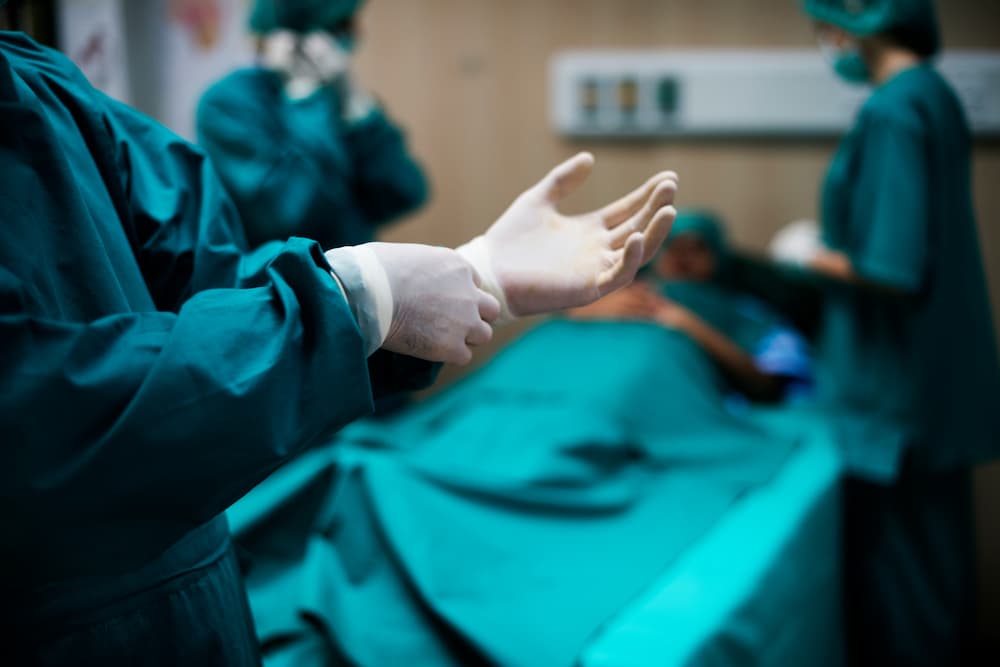
In an operating theatre, cleanliness is not about ‘leaving it spotless’: it is about reducing the risk of contamination and ensuring that the environment is ready for the next procedure with the minimum margin for error.
For this reason, the duties of cleaning staff in an operating theatre are organised in phases, with a defined work sequence, controlled products and tools, and constant coordination with the healthcare team.
Why operating theatres require a different level of cleanliness to the rest of the hospital
Operating theatres are home to invasive procedures, sensitive equipment and high-contact surfaces. Any deviation (a tool that is not touched, an incorrect order, insufficient contact time) can compromise the safety of the patient and staff.
In addition, an operating theatre operates on a rotation and time basis: between surgeries there are brief windows for disinfecting the room, while thorough cleaning takes place at the end of the day. The key is to standardise the process: same phases, same order and verification of results.
Duties of cleaning staff in an operating theatre, depending of the time of day
When we talk about ‘operating theatre cleaning’, we are actually grouping together a set of tasks with different objectives. At Weldon, we usually structure it by operational phases, as this prevents actions (and risks) from being mixed between one phase and another.
This phased approach also helps to define responsibilities, timings and verification: what is cleaned, using what tool, with what product and how it is confirmed that the room is ready.
| Stage | Objective | When it is done | Regular tasks |
| Preparation | Preparing the theatre for cleaning | Before the intervention | Visual inspection, replacement of consumables, checking of tools, support cleaning |
| Between interventions | Recover the room quickly and safely | After each surgery | Waste removal, disinfection of contact surfaces, treatment of the floor in the work area |
| Terminal | Restore hygienic conditions in the room | End of shift/day | Comprehensive cleaning of furniture, accessible walls, high areas, doors, entire floors |
| In-depth / special | Act in the event of increased risk | Isolations, incidents, scheduling | Greater surface coverage, reinforced protocols, strict control of tools and waste |
Before the intervention: preparation and ready for use
The preliminary phase focuses on verifying conditions and ensuring that the operating theatre has everything it needs without introducing inappropriate elements. It is not a matter of ‘cleaning for the sake of cleaning’, but rather of ensuring that the circuits are correctly assembled.
At Weldon, we place great importance on this phase being predictable: if the preparation varies depending on who is working, the risk of oversights and rework increases.
- Use of PPE in accordance with the centre’s protocol and risk assessment.
- Checking of tools specific to the area (trolley, mops/cloths, signage, containers).
- Visual inspection of surfaces and contact points: doors, controls, handles, counter tops.
- Replacement of bags, consumables, and hygiene materials as specified by the centre.
The conclusion of this phase should leave one thing clear: the room is ready to enter the care circuit without improvisation.
Between interventions: speed without skipping the order
Between surgeries, the main aim is to recover the room with a ‘surgical’ approach to cleaning as well: prioritise critical areas (contacts and the immediate environment of the field) and respect the sequence so as not to redistribute contamination.
At Weldon, we tend to work with a simple logic: from top to bottom, from less exposed areas to more exposed areas, and always with controlled tools to avoid spreading contamination.
- Removal and segregation of waste according to type (sanitary, sharp objects, etc.) following the centre’s circuit.
- Disinfection of high-contact surfaces and support furniture (including controls and handles).
- Treatment of the floor in the work area, avoiding entering and leaving until it is safe for transit.
- Replacement of bags and consumables for the following intervention.
Once concludes, our focus is not to ‘do lots’, but do what is needed in the correct order and respecting action times.
Terminal cleaning: re-establish the room standard
Terminal cleaning is planned to ensure that there are no accumulations in areas that are less evident. Here, the role of the cleaning staff is to extend coverage and leave the operating theatre in a reference condition for the following day or shift.
At Weldon, we integrate this phase into a stable procedure that facilitates supervision: always the same route, the same list of points and the same final verification.
- Complete cleaning and disinfection of furniture, auxiliary tables, doors, and contact points.
- Attention to accessible high points: external lighting, elevated surfaces, visible grates, according to centre protocol.
- Entire floors using the recommended technique (without generating aerosols or unnecessary dispersion).
- Removal and cleaning of the tools used, leaving the equipment ready for the next use.
This phase is the most noticeable in the long term: it prevents build-up and reduces incidents caused by ‘invisible’ dirt.
In-depth or special cleaning: when the risk increases
There are scenarios that require additional measures: surgeries with a high biological load, incidents, spills, or hospital-specific protocols. Here, the key function is to follow the procedure without cutting corners and to document what has been done.
If required by the centre, additional controls are incorporated: more frequent changing of tools, exit circuits and confirmation by supervisor or assigned manager.
- Immediate spill management using the product and method established by the centre.
- Greater coverage of surfaces and adjacent areas, according to the defined scope.
- Strict control of the material used (use, removal, cleaning or disposal).
The objective is not to ‘make it perfect’: it is to make it safe and compliant with protocol.
Which points are ‘critical’ in an operating theatre (and why)
Effective cleaning is determined by risk, not aesthetics. Therefore, an essential function of the personnel is to first identify and treat the points of greatest contact and the areas close to the work field.
In our operations, when there is little time, priority is given to what has the greatest impact: surfaces touched by multiple professionals and items that can act as indirect vectors.
- Doors, handles, push buttons and switches: high frequency of contact.
- Auxiliary tables and support surfaces: constant contact during preparation and replacement.
- External controls and switches for equipment and lighting (when the protocol allows them to be cleaned by cleaning staff).
- Floor area around the surgical site: risk of dragging and splashing.
This achieves a real standard: interrupting the chain of indirect transmission in the environment.
Products, tools and trolley: control functions that prevent cross-contamination
In an operating theatre, the selection and management of materials is part of the job. It is not a logistical detail: it is a preventive function. The general rule is to use products authorised for healthcare settings and to apply exactly the dilution, method and time indicated by the manufacturer and the centre’s protocol.
It is also essential that the material be exclusive or clearly segregated for the area, with colour coding if the centre applies it. At Weldon, we treat it as a ‘closed circuit’: what enters the operating theatre does not get used in other areas.
- Cloths and mops designated for the area (preferably with controlled usage and replacement).
- Cleaning trolley prepared before entering, with everything necessary to avoid unnecessary trips.
- Containers suitable for immediate waste segregation.
- Signage to prevent access during drying or critical operations.
The function here is twofold: to clean and to control the process so that it is repeatable and auditable.
Coordination with the surgical team and quality control
A less visible part of the work is coordination. Cleaning staff must know when to enter, what they can handle and what remains the responsibility of other teams (e.g. certain items of clinical equipment or instruments, depending on how the centre is organised).
At Weldon, we insist that communication be brief and to the point: confirm completion of the intervention, incidents (spills, misplaced equipment, special waste) and condition of the room for the next use.
- Use of PPE and compliance with occupational risk prevention measures at all times.
- Recording and traceability when required by protocol (cleaning report, checklist, incidents).
- Final verification by route: surface by surface and area by area, without ‘skipping’.
If you want to broaden your perspective beyond the operating theatre, here is a practical guide to the duties of hospital cleaning staff and how they vary depending on the area.
Common mistakes in operating theatre cleaning and how to avoid them
Mistakes usually stem from the same causes: rushing, lack of standardisation, or poorly managed tools. The team’s role is not to ‘go faster’, but rather not to lose control of the method when the pace picks up.
These are common mistakes and how to prevent them in a practical way:
- Reusing the same cloth in different areas: solution, planned replacement and usage control.
- Alter the order (from floor to surfaces): solution, fixed route, and sequential training.
- Entering and leaving in search of material: solution, prepared trolley and checklist before accessing.
- Confusing cleaning with disinfection: solution, correct product and adherence to the action time.
- Failure to report incidents (spills, special waste): solution, clear communication channel.
When the method is well defined, the team gains in safety and consistency, and the operating theatre becomes a stable process rather than a constant emergency.
If your goal is to standardise procedures, build teams and maintain continuous operational control in critical areas, at Weldon we clean hospitals using specific protocols for high-risk environments such as operating theatres, adapting to the actual operations of each centre.